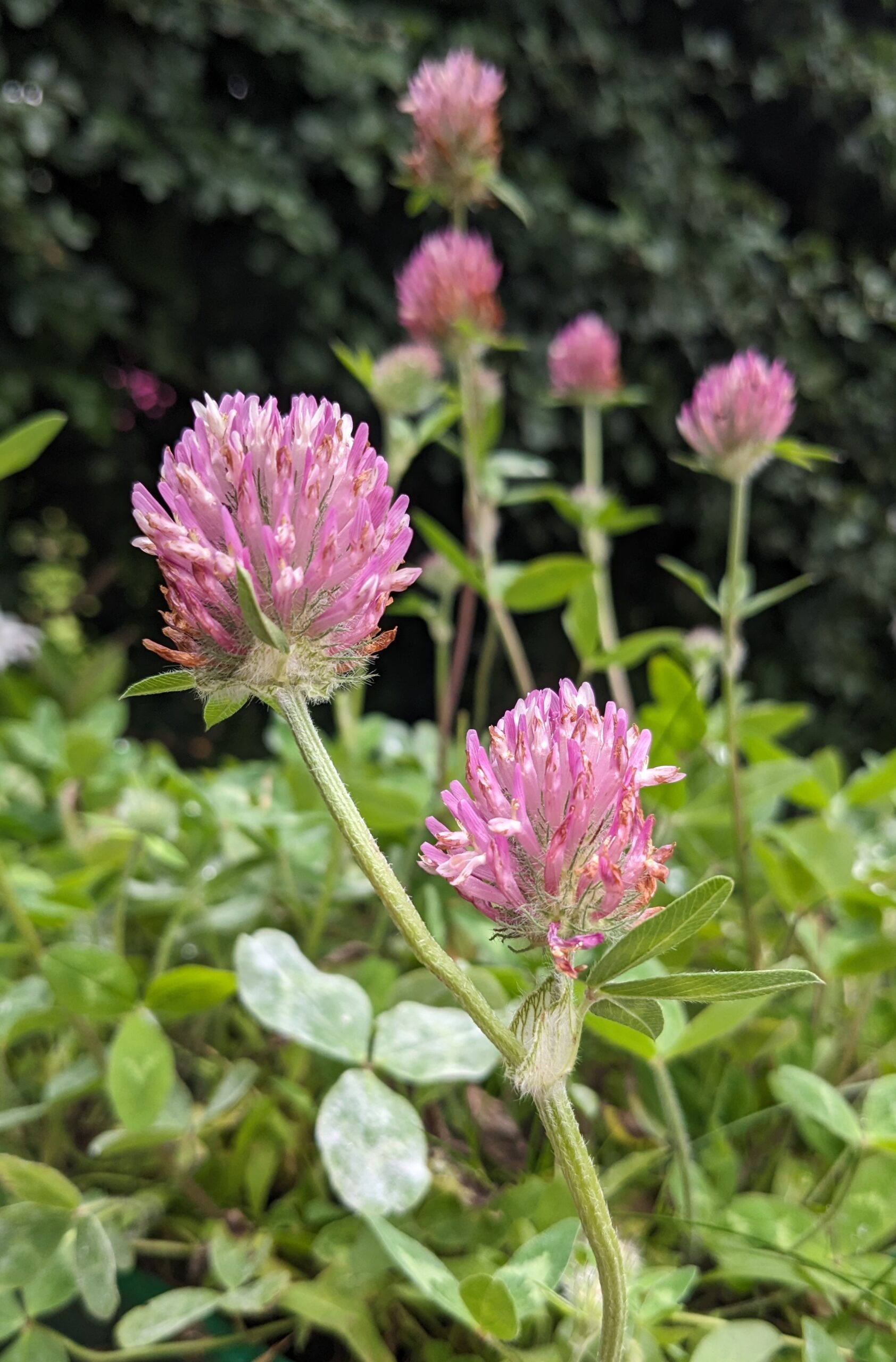
Wild red clover (Trifolium pratense) and white clover (Trifolium repens) are both nativeperennials. They flower from late April to September, to a height of 20 to 40 centimetres. Clovers consist of tiny flowers grouped into egg-shaped heads at the tip of stems. The red clover flowers are pinkish purple, and the white clover flowers are off-white to pale pink. Each plant has many leaves, each leaf being made up of 3 leaflets.
Locally you’ll find clovers in most types of grassland habitats, parks and lawns. It grows best in well-drained or dry soils. Clovers will prefer full or partial sun. For the garden, they grow well in a border, wild areas, containers, flowering lawn and are an essential plant for a summer meadow. Clover flowers propagate by seed and by division.
Clovers are valuable for wildlife: their pollen and nectar make it the most important forage plant for bees, including the common carder bee, honeybee and red-tailed bumblebee.
The roots of clover have tiny nodules containing bacteria which converts nitrogen from the air into salts that are essential for enhancing soil fertility. They are therefore excellent plants for the allotment; they can be used as a green-manure crop, digging the plant into the soil in the spring, or planted as a companion plant where it will fertilise the soil, supress weeds and attract pollinators. Whichever way you chose to use clover your veg will benefit indirectly.
Interesting facts:
- The “lucky” four-leaf (or to be more accurate: leaflets) clover is a genetic anomaly of the white clover and is found in less than 1 in every 5000 plants.
- In the 19th and 20th centuries, clover accounted for three-quarters of the entire UK honey harvest!
- Agricultural varieties of red clover (Trifolium sativum) are bigger than wild red clover, but don’t produce much nectar for pollinators.
More detail on how you can grow meadowsweet can be found on our Wildflowers for Sale page.